How ESD Chairs and Anti Static Floor Tiles Support Safer Modern Electronics Workspaces
Workplace seating is sometimes overlooked when businesses design static-control areas. However, chairs can move and interact with clothing, floors, and workstations throughout the day. Quality esd chairs are designed to dissipate static rather than allowing charge to accumulate around the operator, making them useful in electronics manufacturing, laboratories, repair centres, and other controlled environments.
ELCOM provides ESD seating in several configurations, including fabric and vinyl models, ergonomic chairs, saddle stools, and sit-stand posture stools. Its ergonomic ESD fabric chair is designed for electronics applications and includes adjustments for seat tilt, backrest position, and chair height.
Comfort is an important part of workstation design. Employees may sit for extended periods while inspecting circuit boards, assembling components, or performing repairs. An ergonomic chair can support better working posture while its ESD properties contribute to the overall static-control system.
Material selection can also influence workplace suitability. Fabric chairs may be attractive where comfort is the priority, while vinyl models can offer practical advantages in environments where easy cleaning and stain resistance are important. Businesses should consider cleaning routines, workspace conditions, operator comfort, and ESD requirements before choosing a model.
Flooring provides another essential layer of protection. Workers continually move between benches and equipment, so static control should extend across the areas where they walk and work. Suitable flooring helps provide a controlled path for charge dissipation when correctly installed and combined with appropriate grounding and footwear.
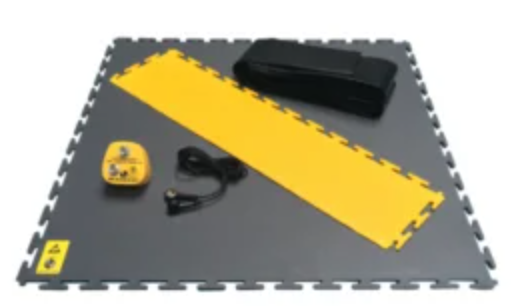
Modular flooring can be particularly useful where businesses need flexible installation. ELCOM’s ESD anti-fatigue flooring includes interlocking tile options designed for industrial areas. Some tiles use a heavy-duty rubber construction and are available with grounding accessories and optional ramp edges.
The relationship between chairs and flooring should not be ignored. A static-safe chair operating over an unsuitable floor may not provide the complete protection expected from a coordinated ESD system. Similarly, a controlled floor requires compatible footwear or grounding methods to provide an effective route for static charge.
Maintenance is essential for both products. Chairs should be checked for damage, worn components, and electrical continuity where applicable. Flooring should be kept clean and inspected for damage or loose sections. Any maintenance products used should be compatible with ESD requirements.
Businesses should also establish routine testing procedures. Testing helps confirm that resistance and grounding remain within the required limits. Documentation can support internal quality procedures and provide evidence that the static-control system is being maintained responsibly.
When properly integrated, anti static floor tiles and ESD seating can form complementary parts of a modern static-control workspace. Alongside ESD benches, mats, footwear, clothing, grounding, and appropriate procedures, they help businesses reduce static risks while supporting comfortable and efficient working conditions.


Comments
Post a Comment